
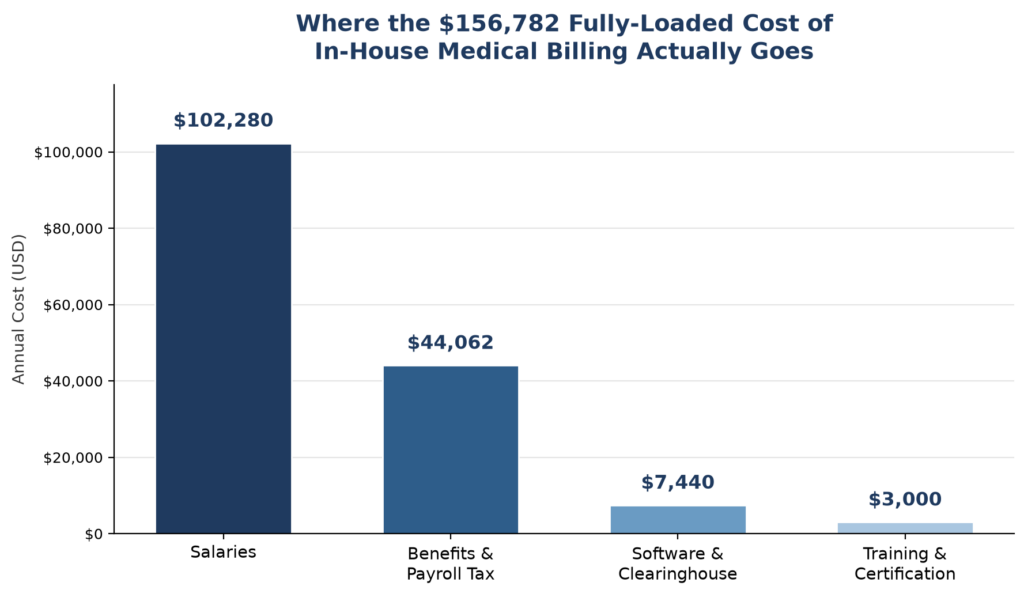
TL;DR / Key Insights Summary: Running an in-house medical billing department typically costs independent practices between 8% and 12% of total revenue once salaries, benefits, software licensing, and clearinghouse fees are aggregated. Transitioning to an outsourced Revenue Cycle Management (RCM) firm like Archer & Clay reduces these operational expenses to a predictable 4% to 7% of collected revenue. This strategic shift eliminates fixed overhead, stabilizes clinical cash flow, and eliminates administrative vulnerabilities caused by staff turnover.
Many healthcare practices evaluate internal billing costs strictly by looking at their biller’s base hourly wage. However, true in-house administrative overhead stretches far beyond basic payroll. To find the real financial footprint, independent medical practices must calculate five distinct cost centers:
The fundamental difference between internal departments and professional RCM partners is the cost structure. In-house billing represents a heavy fixed cost that you must pay regardless of your clinical volume. Professional RCM is a variable cost directly tied strictly to your actual cash collections.
| Financial Cost Center | In-House Billing Department | Archer & Clay Outsourced RCM |
|---|---|---|
| Monthly Cost Structure | Fixed: Salaries and software fees remain identical even if collections drop. | Variable: Fees are a direct percentage of paid claims. We only get paid when you do. |
| Technology Upgrades | Practice Expense: Provider pays for all clearinghouse upgrades and billing software modules. | Included: Enterprise-grade claim scrubbing and RCM technology stack included. |
| Turnover Vulnerability | High: A sick day or sudden employee departure halts your entire cash flow cycle. | Zero: A dedicated corporate infrastructure ensures continuous, daily claim operations |
| Claim Scrubbing Layer | Manual/Basic: Limited by the specific software and time constraints of local office staff. | Advanced: Multi-layered programmatic scrubbers prevent errors before submission. |
We believe that all healthcare businesses need steady cash flow to grow. When an independent practice relies on a small internal team, its cash flow is naturally fragile. If an internal biller falls behind on clearing credentialing errors or managing insurance denials, the practice’s Days in Accounts Receivable (AR) skyrocket.
A medical practice with a high fixed overhead and delayed insurance reimbursements cannot cleanly fund its daily operations. By outsourcing revenue cycle management, you switch from paying for administrative presence to paying purely for administrative performance. This transformation lowers operational strain and uncovers the immediate, predictable cash flow needed to systematically scale your practice. Partner with Archer & Clay to eliminate billing overhead and focus on what matters most: exceptional patient care.
Running an in-house billing department typically costs 8% to 12% of total revenue once salaries, benefits, software licensing, and clearinghouse fees are factored in.
Outsourced RCM firms like Archer & Clay typically reduce that cost to a predictable 4% to 7% of collected revenue.
Gross compensation and benefits, billing software and technology licensing, clearinghouse and transaction fees, office operations and footprint, and staff turnover and training overhead.
In-house billing costs stay the same even if collections drop, while outsourced RCM fees are a direct percentage of paid claims — the provider only gets paid when the practice does.
A single internal biller leaving can halt a practice’s entire cash flow cycle due to lost continuity and recruitment costs, whereas an outsourced RCM partner provides continuous, uninterrupted claim operations.

Liked this post? Share with others!
Maximize your practice's financial health by subscribing to the Archer & Clay newsletter. Designed specifically for independent medical care providers, our updates deliver critical insights on healthcare regulatory shifts, payer trends, and Revenue Cycle Management strategies. By joining, you will also receive advanced notices on specialized medical billing services and tailored solutions built to reduce your administrative burden. Subscribe today to protect your revenue and keep your practice running efficiently.